Notes on Beauty and Knowing
Thoughts on aesthetics

Can aesthetics be scientific? That is to say, is there any sense in which one’s aesthetic beliefs can be rigorously justified, or perhaps even more precisely, can one’s aesthetic beliefs be reasonably falsified. If aesthetics can be falsified there might be some kind of scientific basis for aesthetics. If it is not the case, aesthetics begins to feel more mystical. Perhaps “progress” is possible in either case but they seem like two fundamentally different worlds.
(I choose to use the word aesthetics here to discuss beauty and knowledge, because I believe that one definition of aesthetics is that which one knows to be beautiful)
Say I believe a certain building is beautiful. What exactly led to this belief? Undoubtedly there is some social context. I have some corpus of buildings in my memory that I have seen before - for each of these buildings I have some sense of its function, the architectural tradition to which it belongs, and maybe even more specific historical context. When I see a new building I use this contextual memory as something like a “map” to triangulate where this new building fits.
This “map” is many-dimensional - there might be bases (eigenvectors) for some very large number of factors: height of the building, degree of neo-gothic elements, the degree to which the roof is curved in an east-asian style, etc.). What’s more there may be significant interaction effects between these individual elements. A Chinese Pagoda with western-european gargoyles would likely be off-putting and unaesthetic, but not because either of those individual elements are flawed, but rather there is some sense in which they don’t belong together.
So there is some sense in which aesthetic judgment is based both on individual elements, but also on how those elements interact with each other to make up a whole. But what criteria is being used to evaluate these elements?
There is some balance of repetition and novelty, or symmetry and asymmetry, or pattern and breaking of a pattern that is found in aesthetics. On one extreme, a circle is rotationally symmetric around any degree of movement and has reflectional symmetry around infinitely many lines - but aesthetically it is not very interesting. On the other extreme, random points in a plane (white noise) are entirely unpredictable and novel - there is no symmetry along any axis - yet it is still unaesthetic.
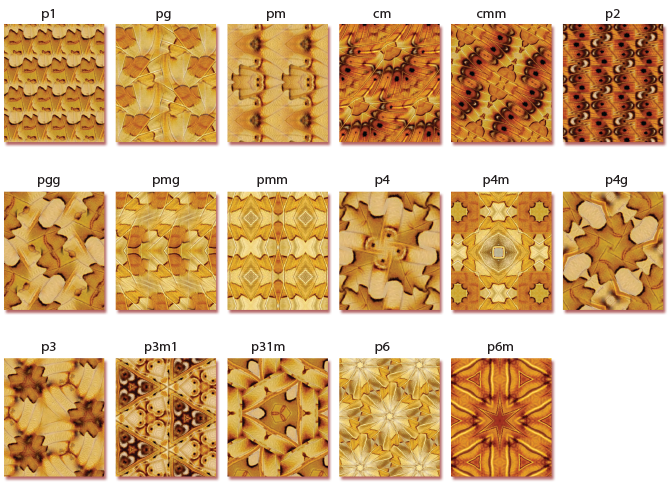
When we begin to relax either of these constraints (total symmetry or total noise) even slightly, we rapidly see beauty appear. Towards the symmetrical extreme, a famous mathematical example is the 17 wallpaper groups which are found in art and architecture throughout the world. In these we see translational symmetry but not necessarily rotational or reflectional symmetry.
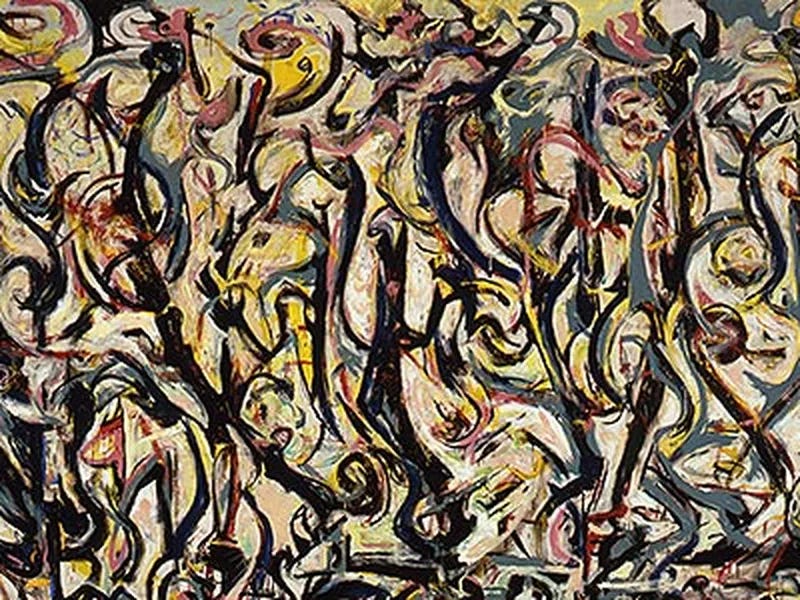
On the other hand, Jackson Pollock’s work is famous for its near random smattering of lines and figures, yet even here, there is an undeniable repetition to the colors, shapes, and positions that makes the work far from truly random noise, and aesthetically appealing to at least some.
Symmetry and noise are only two words, or frames, through which to view what I believe is a far deeper concept. Another framing of this concept is the distinction between stasis and change. The purely symmetric is static, although the axis of symmetry in this case is time. Change implies a lack of temporal symmetry. Neither stasis nor change are inherently good or bad.
Since the big bang the world has been changing. Humans, and agents of all kinds, need to be willing to change to adapt to the world around them. Equally humans cannot allow themselves to change indiscriminately. There are patterns, habits, and lessons embedded in human culture and biology that are true in that they have not been falsified yet - they have thus far been descriptively accurate. Being able to recognize the distinction between what needs change and what needs stasis is fundamental to recognizing beauty.
The most primal instance of the tradeoff between change and stasis is sexual reproduction. The most primal form of beauty is sexual beauty. Participants recognize traits in their mates that they feel will lead to the optimal outcomes for their offspring. An exact replica of oneself errs far too much towards stasis - incidentally this is why concerns regarding immortality are justified and why bans or taboos on incest exist. We are also seeing this in America’s gerontocracy today - say what you will about 80 year old leaders, but aesthetic they are not. However, when two sets of genes are exchanged, variance is in some sense optimized.
I am not arguing that sexual beauty and aesthetic beauty are analogous. I am arguing they are in fact different facets of the fundamental concept of beauty, and beauty is the algorithm that optimizes between stasis and change, between symmetry and noise, between identity and growth.
Sexual beauty drives the urge to reproduce, to create new agents (humans or animals) who will be best suited to survive and propagate their genetic and memetic content through the future. Similarly aesthetic beauty, whether it is architectural, cinematic, musical or of any other domain, will be recognized for its ability to bring new memetic content into this environment. This content, while not alive itself, is imbued with life due to the perception of agents who can recognize and propagate its beauty.
I think this framework begs the question - is beauty simply that which is most memetic? To this I reply no. Beauty is that which is true, though I grant some truths may change over time depending on the cultural context, while others are eternal. Some cultural trends may be memetic for a period of time, but there will always be some limit at which the exponential growth of the viral memetic system is capped.
When some existing pattern is broken - i.e. the pattern has been falsified - an attempt can be made at the creation of new knowledge. Asking whether this attempt is beautiful is the same asking whether the attempt captures true new knowledge being created. If this new knowledg is true it will be recognized as such by other agents and will be propagated in the world. This is because what is true is what is useful. True knowledge allows agents to better inform their predictions and actions in the world and subsequently allows them to better express their wills. True knowledge informs your intimacy with reality.
In many ways, this is why science is so powerful - because it codifies the creation of new knowledge in a system that is repeatable, and as any scientist will tell you, the creation of this new knowledge carries a real sense of beauty. That is not to say all new knowledge is scientific - when a new fashion or culture is created in some non-scientific domain: art, writing, music, etc. - if this culture is recognized as beautiful it is grasping at a truth. Truths in these domains may be recognizable by humans although not graspable by scientific means in the present moment.
Many of these “cultural” truths are somewhat mundane in that they are self-referential towards other aspects of culture, and do not have much deeper significance than that. These ideas may virally memetic for a short period of time, but tend to express a shallower truth.
This concept is captured in the barber pole model of fashion. The linked article is worth the read, but to summarize this succinctly - different “classes” of people want to look like the class above them, and the resulting dynamic equilibrium is that a lower “class” tends to copy the style of the class above them, until a threshold is reached by the upper “class” such that their style is changed entirely. Thus there is some truth in the signaling used when young boys decide to get perms showing truthfully they are part of a new generation, something that 15 years ago would have been unthinkable for boys of this age and that in another 15 years will likely be equally unthinkable. Perms may come and go but it is hard to recognize any eternal truth in their existence.
Hence these trends in hair, fashion, and diction tend to be highly self referential, whereas trends in novels, music, and art tend to be less so. We no longer wear powdered wigs and tunics, yet we still listen to Beethoven and read Tolstoy. The truths expressed in the latter, while less straightforward, have proven to resonate with millions of individuals over hundreds of years.
To conclude I will return to the question: Can aesthetics be scientific? I would like to argue that aesthetics necessarily are scientific in that the judgment of aesthetics is exactly the recognition of truth - but these truths are not a priori recognizable. They are true only in so far as they are evaluated against physical reality at which point they can be falsified in a Popperian sense.
Still there remains something mystical about one’s own sense of aesthetic judgment. How are you to know whether your initial aesthetic judgment is correct, when you have not yet had data to falsify this judgment? Here I would like to argue that your sense of aesthetic judgment is literally your classification algorithm based on the “training data” you have seen. People can have better and worse senses of aesthetics - and this can vary across individuals across domains. You will not make every aesthetic judgment correctly (although I believe that most people have enough aesthetic sense, that if they would follow this sense honestly they would do better by themselves). What is important is that you are willing to update your algorithm as you are exposed to more data. Those who don’t make such changes become increasingly detached from the real world as they stubbornly refuse to update their beliefs as they conflict with reality.